-
Closing the Readiness Gap: How Adaptive Learning Can Support the Next Generation of Healthcare Workers
Corrie Halas, VP of Clinical Learning, Amplifire
Healthcare organizations are onboarding a new generation of clinicians into the most complex care environments in history, yet many leaders worry they’re not fully prepared for the realities of the role.
The Readiness Gap Is Real—and Growing
Recent coverage in Becker’s Hospital Review highlighted a growing concern among leaders: many Gen Z employees entering the workforce are not fully prepared to navigate professional environments. Psychologist Tessa West notes that a combination of pandemic-era remote education and asynchronous communication has left many younger workers uncertain about expectations, communication norms, and how to respond to feedback. In healthcare, where the stakes of decision-making and teamwork are high, this readiness gap can affect confidence, performance, and ultimately retention.
This concern is not just theoretical. At the VIVE conference last month, I heard this theme repeatedly from healthcare leaders across the country: workforce readiness is becoming one of the most pressing challenges facing health systems today. Many leaders spoke candidly about the growing number of less experienced nurses entering the workforce and the difficulty of ensuring they feel confident and prepared in increasingly complex clinical environments.
Why Training Completion Isn’t Enough
Health systems are already responding with thoughtful strategies such as mentorship programs, clearer communication guidelines, and defined career pathways. These efforts are important, particularly for a generation that values regular feedback and visible opportunities for growth. But alongside mentorship and leadership development, organizations also need a reliable way to understand whether new hires truly grasp the knowledge and decision-making required for their roles.
Building True Readiness at Scale
This is where adaptive learning can play a powerful role. Traditional education models often measure completion rather than readiness, assuming that once a course is finished, a learner is prepared. Adaptive learning takes a different approach by continuously assessing knowledge and identifying gaps, especially misconceptions that learners may hold with high confidence—what we define as Confidently Held Misinformation (CHM™), the most dangerous form of knowledge gap in high-stakes environments.
For Gen Z employees, adaptive learning also aligns with how they prefer to learn. Short, personalized learning experiences provide immediate feedback and clarity, helping new hires build confidence while reducing the “guessing game” that Dr. West describes. When learning adapts to the individual rather than forcing everyone through the same content, organizations can accelerate competency development without increasing the time burden on busy clinicians or educators.
Ultimately, readiness is more than training completion. Readiness is the confidence and competence to apply knowledge in real situations. As healthcare organizations continue investing in mentorship, leadership development, and career pathways, adaptive learning can serve as the readiness engine that ensures those investments translate into capable, confident clinicians. In a workforce environment defined by generational change and increasing care complexity, closing the readiness gap may be one of the most important strategies for supporting both workforce stability and patient outcomes. In a workforce environment defined by generational change and increasing care complexity, closing the readiness gap is not just a learning initiative—it is a patient safety and workforce stability strategy.
-
The Evolution of Learning in High-Stakes Industries: From One-Size-Fits-All to AI-Powered Readiness
In high-stakes industries, training can no longer be measured by completion alone. Healthcare, manufacturing, energy, and other complex environments require more than employees who finished a course — they require workforces that are proven ready to perform safely, accurately, and confidently.
The challenge is clear: traditional training methods often fail to identify the critical gap between participation and true competence. Employees may complete required learning while still carrying knowledge gaps or confidently held misinformation that can lead to costly mistakes, compliance failures, safety incidents, and operational risk.
AI is changing that equation.
Today’s most advanced learning technologies are not replacing human expertise — they are making workforce learning measurable, adaptive, and accountable. By combining AI with proven brain science, organizations can move beyond tracking engagement and begin validating real readiness, mastery, and performance.
This shift represents a new standard for workforce development:
- from completion to competence
- from compliance to confidence
- from training activity to measurable outcomes
Organizations that embrace this evolution gain more than better learning metrics. They build safer, more capable workforces equipped to perform in critical moments — supported by actionable insights that reveal where risk exists before it becomes failure.
Download the full whitepaper to explore how AI-powered, brain-science-based learning is reshaping workforce readiness in high-stakes industries.
-
Meet the Future of Learning: A Personal AI Instructor for Every Learner
What if every learner had access to a personal instructor that adapts in real time, understands exactly where they are struggling, and helps them move forward with confidence?
We are introducing Amplifire’s AI Learning Experience, powered by Cognix, our AI intelligence layer built on fifteen years of brain science and over five billion learner interactions. This is a fundamentally different approach to workforce training. It does not deliver content. It delivers proactive, one-on-one instruction at scale.
The experience adapts to each learner in real time, identifying what they are confident about but wrong about and correcting it before it becomes a costly mistake. This is how organizations move beyond completion tracking to verified competence and measurable behavior change.
Now available in early access, this is a major step toward personalized instruction that works at enterprise scale. When learning matters, this is what it should look like.
From Content Delivery to Real Understanding
Most learning tools are built to deliver information. Real learning comes from interaction, guidance, and timely feedback.
The AI Learning Experience becomes part of the learning process itself. Built on Amplifire’s foundation in brain science and informed by billions of learner interactions, it meets each learner where they are and keeps them focused as they progress. Instead of overwhelming learners with content or distractions, it guides them step by step through the material in front of them.
This is not a generic AI chatbot pulling answers from the internet. It works directly from your course materials, ensuring every interaction is grounded, relevant, and aligned to what the learner is trying to master.
And it does not simply give answers. It creates learning moments. When a learner struggles, it helps them think through the problem, understand why something is correct, and correct misconceptions so knowledge actually sticks.
Built for Trust. Ready for Now.
Bringing AI into learning environments requires more than innovation. It requires trust.
We have taken a deliberate approach to ensure this experience aligns with strong standards for AI governance, safety, and effectiveness. Grounded in the same brain science that powers Amplifire and refined through billions of learner interactions, this experience is designed to drive real understanding, not just activity. The result is something that is not only powerful, but ready to be used in real learning environments today.
Early Access Momentum
The excitement is already building. Learners are engaging more deeply, asking better questions, and staying with challenging material longer.
Mercy, one of our early users, captured it perfectly:
“It feels like I finally have someone walking me through the material instead of just testing me on it.”
That is the shift. Learning that feels supported, not evaluated.
What Makes the AI Learning Experience Different
What sets this apart is not just the technology, but the intelligence layer behind it. Powered by Cognix, Amplifire’s AI is built to deliver instruction that actually changes behavior.
- Grounded in brain science
Built on fifteen years of research into how the brain encodes, retains, and retrieves knowledge, and informed by over five billion learner interactions - Adaptive to what each learner actually knows
Continuously detects knowledge gaps and confidently held misinformation, then adjusts instruction in real time - Built from your content, not the open internet
Every interaction is grounded in your validated materials, ensuring accuracy, relevance, and control in high-stakes environments - Proactive instruction, not reactive answers
Delivers what learners need to know before the moment of application, rather than waiting for the right question - Designed for measurable mastery
Focuses on correcting misconceptions and proving knowledge change, not just guiding learners to completion
Get Early Access
This is just the beginning. We are inviting customers to get early access and help shape what comes next.
The future is not just smarter technology. It is smarter learning for every individual.
- Grounded in brain science
-
Precision Learning Cuts Audit Training Time by 80% at Cohen & Co
To modernize its auditor onboarding and keep pace with rapid growth, Cohen & Co needed a more scalable approach to training—without sacrificing the experiential learning that made its mock audits effective. By partnering with Amplifire, the firm transformed a 3+ day, SME-dependent program into a streamlined, adaptive learning experience that delivers targeted instruction based on each learner’s knowledge and confidence.
The results were immediate and measurable. Training time was reduced to under seven hours while maintaining performance outcomes, increasing learner engagement, and freeing SMEs to focus on high-value coaching. With greater flexibility, reduced costs, and real-time insight into workforce readiness, Cohen & Co now delivers faster onboarding and a more scalable model for developing audit talent—proving that when learning matters, precision drives performance.
-
LTEN Demo Days 2026
Amplifire presented at LTEN Demo Day in April 2026
Life sciences organizations face unprecedented pressure to ensure commercial, medical, and compliance teams are fully prepared—especially during product launches, label updates, and regulatory change. In this session, Amplifire will demonstrate how AI-powered, brain science-based adaptive learning accelerates field readiness while delivering audit-ready proof of training effectiveness. Unlike traditional eLearning that measures completion, Amplifire personalizes the learning experience and identifies knowledge gaps before they create compliance risk or CAPA failures. You will see how personalized learning paths, advanced analytics, and rapid AI-powered content authoring work together to reduce time to proficiency, protect brand integrity, and ensure teams are ready to perform where the stakes are highest.
Fill out the form below to watch the video from the April 2026 webinar
-
Stanford Health Care Took the Stage at HIMSS to Share Their EHR Training Success
We were honored to see this work come to life during Stanford Health Care’s presentation at HIMSS Global Health Conference & Exhibition last week. Anne Hyland, Vice President of EHR Learning, and Michael Walker, Senior Director of New Business at Amplifire, were able to hear first-hand how their team handled the challenges and the measurable outcomes they’ve achieved. It was a powerful reminder of what’s possible when innovation is paired with a clear focus on outcomes.
What stands out most is Stanford Health Care’s thoughtful approach to modernizing onboarding. Rather than accepting traditional, one-size-fits-all training, they’ve embraced a more personalized, data-driven model that meets clinicians where they are, respecting prior experience while ensuring mastery of critical workflows. The result is not only greater efficiency, but a more confident, prepared workforce ready to deliver high-quality care from day one. As highlighted in their broader work, this approach has also enabled earlier identification of struggling learners and more targeted support, ultimately strengthening both performance and satisfaction.
Stanford Health Care continues to set the standard for innovation in workforce development, and their recent feature in Healthcare IT News highlights just how impactful that work has been. By reimagining EHR training, their team has successfully reduced training time by 50% while simultaneously improving learning retention, an achievement that speaks to both their strategic vision and deep commitment to clinician success.
Congratulations to the entire Stanford Health Care team on this well-deserved recognition. Their leadership is not only advancing their own organization, but helping to shape the future of healthcare workforce development across the industry.
-
Learning at Scale, with Purpose: What We’re Focusing on in 2026
If there is one thing the last year reinforced, it is this: learning still matters deeply, especially when the stakes are high. Across healthcare, financial services, higher education, and other mission-critical industries, organizations are under pressure to do more with less, onboard faster, reduce risk, and support a workforce that is stretched but deeply committed.
As we move through early 2026, we have been reflecting on what we have collectively built with our customers and partners and what that progress enables next.
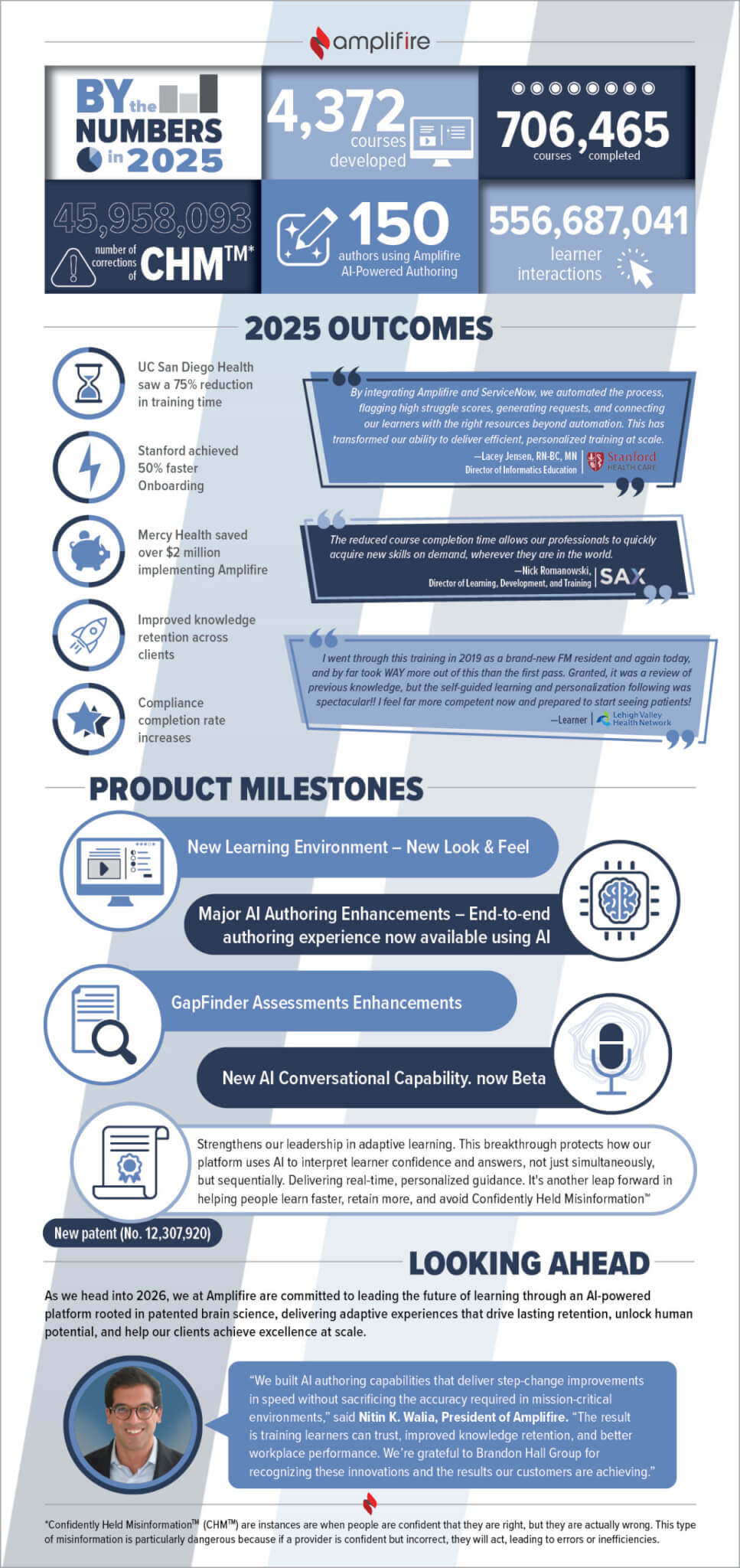
- The scale alone tells a powerful story.
- Over 706,000 courses completed.
- More than 556 million learner interactions.
- Nearly 46 million instances where Confidently Held Misinformation™ was surfaced and corrected.
But the real impact of those numbers is not volume. It is what they represent: people learning more efficiently, retaining critical knowledge longer, and showing up to their work more prepared and more confident.
Click to Enlarge From Activity to Impact
Training activity is easy to measure. Meaningful learning is harder, and that is where outcomes start to emerge.
We’ve seen health systems and organizations translate adaptive learning into tangible improvements.
- UC San Diego Health reduced training time by 75 percent, helping clinicians get where they were needed faster.
- Stanford Health Care achieved 50 percent faster onboarding without sacrificing depth or quality.
- Mercy Health saved over $2 million by modernizing compliance training, freeing up time, budget, and attention for patient care.
These outcomes were not driven by shortcuts. They came from rethinking how learning works, recognizing that not every learner needs the same content, that confidence matters as much as correctness, and that insight into struggle and uncertainty is just as important as test scores.
Across clients, we also saw consistent improvements in knowledge retention and compliance completion. These are quiet wins that do not always make headlines, but they make a real difference in safety, performance, and trust.
Learning That Adapts to People, Not the Other Way Around
One of the clearest themes we heard from learners themselves was appreciation for personalization.
A resident at LVHN reflected on retaking a course years later and coming away with far more value the second time. The content was familiar, but the experience was different. Self-guided, adaptive learning allowed prior knowledge to be respected and gaps to be addressed without friction. The result was greater confidence and stronger preparation for seeing patients.
That sentiment showed up again and again. When learning adapts to individuals rather than forcing everyone through the same path, it becomes something people engage with, not something they endure.
From a global professional services perspective, SAX LLP highlighted how reduced course completion times made it possible for professionals to acquire new skills on demand, wherever they were in the world. In fast-moving environments, time is not just money. It is relevance.
Behind the Scenes: Building Better Tools for Learning
Progress at this scale does not happen without sustained investment in the platform itself. In 2025, we doubled down on innovation with platform improvements including:
- A new learning environment with an updated look and feel designed to reduce friction and make engagement more intuitive.
- Major enhancements to AI-powered authoring, enabling an end-to-end experience that helps subject matter experts move faster without compromising accuracy. Today, more than 150 authors are already using AI as part of their workflow, contributing to over 4,300 courses developed.
- GapFinder Assessments continued to evolve as well, giving organizations clearer insight into where knowledge gaps, uncertainty, and risk actually live before they show up in practice.
We also expanded our AI roadmap with a new conversational capability now in beta and moving toward broader availability. The goal is not novelty. It is support, meeting learners where they are in the moments they need guidance most.
Another important milestone was the issuance of U.S. Patent No. 12,307,920. This strengthens protection around how the platform uses AI to interpret learner confidence and answers sequentially, not just simultaneously. It is a technical achievement with a very human purpose: helping people avoid confidently held misinformation, learn faster, and retain what matters.
Systems, Not Silos
One of the most encouraging signs of maturity we saw was how organizations began integrating learning more deeply into their operational ecosystems.
At Stanford Health, integrating Amplifire with ServiceNow enabled automated workflows that flagged struggle, generated requests, and connected learners with the right resources without adding administrative burden. As Lacey Jensen, RN-BC, MN, Director of Informatics Education, shared, this approach transformed training from something reactive into something responsive and personalized at scale.
This kind of integration signals a broader shift. Learning is no longer a standalone event. It is becoming part of how organizations sense risk, support people, and continuously improve.
The Human Side of Scale
For all the technology, patents, and metrics, what we are most proud of is the community behind the work.
Customers who co-develop content and share what they are learning. Educators and clinicians who push for better ways to train their teams. And internally, a group of people who care deeply about the impact of what they build.
As one team member put it, there is something rare about working in a place where you can make a difference, trust your leadership, and genuinely enjoy the people around you. Another reflected on how being together, stepping away from screens and roadmaps, was a reminder that the best feature of the platform might actually be the people behind it.
That culture matters because learning is fundamentally human. Tools can accelerate it, but empathy, collaboration, and integrity sustain it.
Carrying Momentum Forward
As we continue into 2026, the focus is not on celebrating past milestones. It is on building from them.
The challenges facing today’s workforce are not easing. Turnover, burnout, skills gaps, and rising expectations remain very real. At the same time, there is momentum and proof that smarter, adaptive learning can reduce burden, restore confidence, and create space for people to do their best work.
We remain committed to leading the future of learning through an AI-powered platform rooted in patented brain science. One that drives lasting retention, unlocks human potential, and helps organizations achieve excellence at scale.
Not because learning is trendy.
But because when learning matters, outcomes do too. -
The Future of EHR Training: How Intelligent Learning Drives Clinician Confidence and Reduces Burnout
Summary
EHR training is evolving to support AI-enabled healthcare workflows, clinician burnout reduction, and workforce development. Adaptive learning technology enables personalized training, faster onboarding, improved EHR adoption, and stronger cybersecurity and compliance awareness across health systems.
Anne Hyland, Vice President of EHR Learning, Amplifire
EHR training is no longer about teaching clicks and workflows. Across healthcare organizations, training has become a strategic driver of clinician experience, adoption of AI-enabled workflows, and organizational readiness for an increasingly complex regulatory and cybersecurity environment. Health systems that treat training as an afterthought will struggle to realize the full value of their EHR investments.
At Amplifire, we see EHR training as a catalyst for measurable improvement in efficiency, confidence, and clinician satisfaction. The evolution of healthcare technology, combined with workforce pressures, makes a modern approach to learning essential.
Virtual and Asynchronous Learning Is Now the Standard
The continued shift toward virtual and asynchronous training reflects the realities of clinical practice. Nearly 70 percent of clinicians report that self-paced learning is effective, according to KLAS. Rigid, one-size-fits-all training models are increasingly incompatible with the pace and pressure clinicians face every day.
However, asynchronous delivery alone is not enough. Training must be intelligent. Effective programs identify what users already know, pinpoint knowledge gaps, and focus learning only where it will materially improve performance. Amplifire’s adaptive learning approach ensures clinicians spend time where it matters most rather than repeating information they already understand.
AI-Powered Documentation Requires Smarter Training
One of the most significant shifts in EHR use is the rapid adoption of AI-powered documentation tools, including ambient documentation and virtual scribes. While these technologies promise to reduce administrative burden, they also introduce new risks if implemented without thoughtful education.
Clinicians must understand how to validate AI-generated content, maintain regulatory compliance, and retain clinical accountability. Training must therefore move beyond simple feature education and focus on responsible AI use. Scenario-based learning helps clinicians develop the judgment required to work effectively with these tools while maintaining trust in the documentation process.
Microlearning That Respects Clinician Time and Expertise
Microlearning has emerged as one of the most effective ways to engage clinicians. Short, targeted modules combined with focused courses align far better with real-world schedules than traditional classroom sessions.
Effective training also recognizes that EHR use varies significantly across specialties. Role-specific content feels more relevant to clinicians and improves both engagement and efficiency. By respecting existing knowledge and targeting inefficient habits, adaptive learning delivers education that feels practical and immediately applicable to clinical work.
Cybersecurity Training as Risk Reduction
As cyber threats grow more sophisticated, the importance of effective security training continues to increase. Phishing attacks, ransomware, multi-factor authentication requirements, and evolving HIPAA regulations demand ongoing education rather than annual compliance exercises.
Training has become a frontline defense. Adaptive learning helps organizations reinforce correct behaviors, identify areas of risk across roles, and deliver targeted education that strengthens overall security posture.
Preparing Clinicians for Telehealth and Remote Monitoring
Telehealth and remote patient monitoring continue to introduce new documentation and workflow requirements. Virtual care environments require clinicians to manage device-generated data, document care interactions appropriately, and maintain continuity of care across digital and in-person settings.
These workflows are not intuitive extensions of traditional practice. Focused education is necessary to ensure accuracy, compliance, and efficiency while minimizing additional administrative burden.
The Next Phase of EHR Training
As healthcare technology continues to evolve, AI literacy is becoming a central competency for clinicians. Health systems are defining frameworks for responsible AI use and ensuring that clinicians understand how to interpret AI-driven insights within their workflows. Success increasingly depends on effective collaboration between clinicians and intelligent systems.
At the same time, regulatory and operational changes will continue to introduce new workflow requirements. Electronic prior authorization mandates, expanded automation, and evolving cybersecurity standards will require structured training to avoid delays, errors, and staff frustration.
One-time interventions are no longer sufficient. Continuous, adaptive learning strategies are becoming essential for maintaining proficiency in a rapidly changing clinical environment.
Training That Improves Satisfaction and Reduces Burnout
At Amplifire, our goal is to make EHR training more efficient, more effective, and more human. By respecting existing knowledge, correcting inefficient habits, and focusing education where it matters most, organizations can improve both proficiency and clinician experience.
The connection is clear. Better training leads to higher EHR satisfaction, and improved satisfaction contributes directly to reduced clinician burnout.
As EHR systems become more intelligent and more embedded in clinical decision-making, training will determine whether technology becomes a burden or a true partner in care delivery. Organizations that invest in intelligent learning will be best positioned to ensure their clinicians are confident, capable, and ready for what comes next.
Anne Hyland is the Vice President of EHR Learning at Amplifire. With over 30+ years in learning and development, including in healthcare IT and EHR implementation, education, and change management, Anne is passionate and committed to both the learner experience and the organizational impact of effective learning.
-
2026 Healthcare Alliance Virtual Summit Recap
On February 11th, 2026, we gathered together for the Annual Healthcare Alliance Virtual Summit. 200+ Learning and Clinical Leaders from leading healthcare organizations across the country came together to discuss the power of innovation in learning.
Featuring:
- Froedtert Health showcases the impact of GapFinder Assessments, improving documentation efficiency and closing performance gaps.
- UW Medicine provides an inside look at how their team is leveraging Amplifire Authoring, powered by AI, to transform their learning and development process.
- Tampa General Hospital illustrates how Dynamic Learning and GapFinder Assessments advance annual competencies and empower new-hire APP onboarding across 60+ specialties.
- University of California Health (UCSD, UCSF, and UCLA) shares how system-wide learning strategies and data-driven insights are accelerating innovation and performance across their institutions.

Complete the form below to watch the highlights video!
-
Adaptive Learning as a Strategic Response to a Multigenerational, High-Pressure Environment
Corrie Halas, VP of Clinical Learning, Amplifire
The healthcare industry is at an inflection point. With workforce shortages, increasing patient acuity, digital transformation, rising labor costs, and expanding regulatory demands, the way we train and develop clinical and operational staff can no longer remain static.
To meet today’s challenges and prepare for tomorrow’s healthcare delivery, organizations must embrace adaptive learning as more than an educational tool. It’s a system-level strategy for resilience, performance, and transformation.
The Multigenerational Workforce Challenge
Healthcare teams today include five generations of employees, each with different levels of experience, comfort with technology, and learning styles. This diversity is a strength, but only if organizations adopt learning methods that meet individuals where they are.
Standardized training modules and traditional LMS-based models often fall short. For new hires, it can mean information overload. For veteran staff, repetitive content becomes a source of disengagement. In both cases, the result is lost time, missed opportunities for development, increased variability in patient care, and significant cost.
Adaptive learning changes that by responding to each learner’s current knowledge, identifying gaps, and personalizing the learning path. The result: faster mastery, reduced training fatigue, and better knowledge retention.
Competing Priorities Demand a Smarter Approach
Healthcare organizations are juggling critical, often competing priorities:
- Addressing talent shortages and onboarding at scale
- Maintaining compliance amid shifting regulatory standards
- Reducing burnout while increasing productivity
- Implementing and optimizing digital health tools and EHRs
- Improving safety and quality outcomes in real time
Adaptive learning helps tackle these priorities in parallel. It enables faster training cycles, real-time measurement of competency, and precise alignment with organizational performance goals.
How Adaptive Learning Works
Modern adaptive learning platforms use principles of cognitive science to uncover:
- What learners know
- What they think they know but don’t (a major risk in clinical settings)
- What they need to learn next
- Where knowledge decay is occurring over time
This allows healthcare organizations to close skill gaps, mitigate risk, and reduce time spent on unnecessary training. For clinical roles, this translates to safer care. For revenue cycle, IT, and operational teams, it means fewer errors and faster performance ramp-up. For everyone, it leads to a more confident and capable workforce.
Measurable Impact Across the Organization
Organizations that adopt adaptive learning see clear benefits:
- Reduced turnover from improved employee engagement and development
- Shortened onboarding timelines and fewer disruptions to care delivery
- Improved patient outcomes by targeting confidently held misinformation
- Operational scalability, particularly in multi-site systems or high-growth environments
- Reduced training costs by eliminating time spent on content already mastered
Perhaps most importantly, adaptive learning contributes to a culture of continuous improvement, a critical component for organizations striving to meet quality benchmarks, retain top talent, and remain competitive in value-based care models.
Supporting Patient Safety and Quality Goals
For healthcare leaders focused on patient safety and quality outcomes, adaptive learning offers a direct line of sight between education and performance. By identifying and correcting confidently held misinformation before it reaches the point of care, adaptive platforms help organizations reduce preventable errors, improve adherence to evidence-based protocols, and strengthen their performance on CMS quality measures and value-based care metrics. This targeted approach ensures that education investments directly support patient safety movement methodology (PSSM) and continuous quality improvement initiatives.
The Path Forward
The future of healthcare hinges not just on hiring the right people, but on equipping every team member, regardless of background or tenure, with the knowledge and confidence to succeed in a dynamic environment.
Adaptive learning isn’t a luxury. It’s a modern solution to a modern problem.
As health systems continue to evolve, the question isn’t whether we can afford to change how we train our teams. It’s whether we can afford not to.
About Amplifire
Amplifire is the world’s leading adaptive learning platform, built from patented brain science discoveries and informed by billions of learner interactions. Its AI-powered tools help organizations reduce costs, save time, and improve outcomes through smarter, personalized training. From EHR onboarding to clinical risk reduction, Amplifire partners with high-stakes industries to elevate performance, safety, and satisfaction.