

If there is one thing the last year reinforced, it is this: learning still matters deeply, especially when the stakes are high. Across healthcare, financial services, higher education, and other mission-critical industries, organizations are under pressure to do more with less, onboard faster, reduce risk, and support a workforce that is stretched but deeply committed.
As we move through early 2026, we have been reflecting on what we have collectively built with our customers and partners and what that progress enables next.
- The scale alone tells a powerful story.
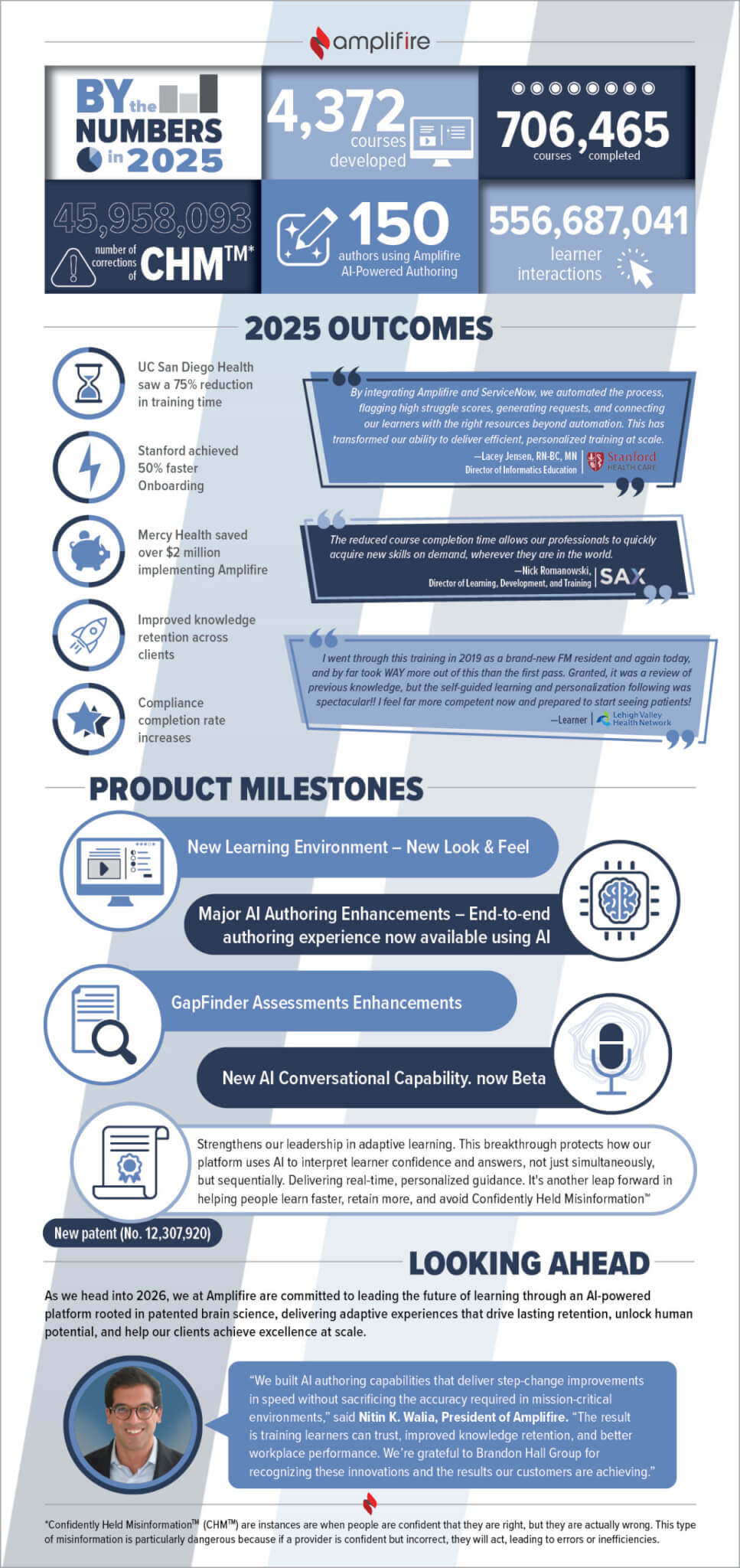
- Over 706,000 courses completed.
- More than 556 million learner interactions.
- Nearly 46 million instances where Confidently Held Misinformation™ was surfaced and corrected.
But the real impact of those numbers is not volume. It is what they represent: people learning more efficiently, retaining critical knowledge longer, and showing up to their work more prepared and more confident.
From Activity to Impact
Training activity is easy to measure. Meaningful learning is harder, and that is where outcomes start to emerge.
We’ve seen health systems and organizations translate adaptive learning into tangible improvements.
- UC San Diego Health reduced training time by 75 percent, helping clinicians get where they were needed faster.
- Stanford Health Care achieved 50 percent faster onboarding without sacrificing depth or quality.
- Mercy Health saved over $2 million by modernizing compliance training, freeing up time, budget, and attention for patient care.
These outcomes were not driven by shortcuts. They came from rethinking how learning works, recognizing that not every learner needs the same content, that confidence matters as much as correctness, and that insight into struggle and uncertainty is just as important as test scores.
Across clients, we also saw consistent improvements in knowledge retention and compliance completion. These are quiet wins that do not always make headlines, but they make a real difference in safety, performance, and trust.
Learning That Adapts to People, Not the Other Way Around
One of the clearest themes we heard from learners themselves was appreciation for personalization.
A resident at LVHN reflected on retaking a course years later and coming away with far more value the second time. The content was familiar, but the experience was different. Self-guided, adaptive learning allowed prior knowledge to be respected and gaps to be addressed without friction. The result was greater confidence and stronger preparation for seeing patients.
That sentiment showed up again and again. When learning adapts to individuals rather than forcing everyone through the same path, it becomes something people engage with, not something they endure.
From a global professional services perspective, SAX LLP highlighted how reduced course completion times made it possible for professionals to acquire new skills on demand, wherever they were in the world. In fast-moving environments, time is not just money. It is relevance.
Behind the Scenes: Building Better Tools for Learning
Progress at this scale does not happen without sustained investment in the platform itself. In 2025, we doubled down on innovation with platform improvements including:
- A new learning environment with an updated look and feel designed to reduce friction and make engagement more intuitive.
- Major enhancements to AI-powered authoring, enabling an end-to-end experience that helps subject matter experts move faster without compromising accuracy. Today, more than 150 authors are already using AI as part of their workflow, contributing to over 4,300 courses developed.
- GapFinder Assessments continued to evolve as well, giving organizations clearer insight into where knowledge gaps, uncertainty, and risk actually live before they show up in practice.
We also expanded our AI roadmap with a new conversational capability now in beta and moving toward broader availability. The goal is not novelty. It is support, meeting learners where they are in the moments they need guidance most.
Another important milestone was the issuance of U.S. Patent No. 12,307,920. This strengthens protection around how the platform uses AI to interpret learner confidence and answers sequentially, not just simultaneously. It is a technical achievement with a very human purpose: helping people avoid confidently held misinformation, learn faster, and retain what matters.
Systems, Not Silos
One of the most encouraging signs of maturity we saw was how organizations began integrating learning more deeply into their operational ecosystems.
At Stanford Health, integrating Amplifire with ServiceNow enabled automated workflows that flagged struggle, generated requests, and connected learners with the right resources without adding administrative burden. As Lacey Jensen, RN-BC, MN, Director of Informatics Education, shared, this approach transformed training from something reactive into something responsive and personalized at scale.
This kind of integration signals a broader shift. Learning is no longer a standalone event. It is becoming part of how organizations sense risk, support people, and continuously improve.
The Human Side of Scale
For all the technology, patents, and metrics, what we are most proud of is the community behind the work.
Customers who co-develop content and share what they are learning. Educators and clinicians who push for better ways to train their teams. And internally, a group of people who care deeply about the impact of what they build.
As one team member put it, there is something rare about working in a place where you can make a difference, trust your leadership, and genuinely enjoy the people around you. Another reflected on how being together, stepping away from screens and roadmaps, was a reminder that the best feature of the platform might actually be the people behind it.
That culture matters because learning is fundamentally human. Tools can accelerate it, but empathy, collaboration, and integrity sustain it.
Carrying Momentum Forward
As we continue into 2026, the focus is not on celebrating past milestones. It is on building from them.
The challenges facing today’s workforce are not easing. Turnover, burnout, skills gaps, and rising expectations remain very real. At the same time, there is momentum and proof that smarter, adaptive learning can reduce burden, restore confidence, and create space for people to do their best work.
We remain committed to leading the future of learning through an AI-powered platform rooted in patented brain science. One that drives lasting retention, unlocks human potential, and helps organizations achieve excellence at scale.
Not because learning is trendy.
But because when learning matters, outcomes do too.