-
Learning at Scale, with Purpose: What We’re Focusing on in 2026
If there is one thing the last year reinforced, it is this: learning still matters deeply, especially when the stakes are high. Across healthcare, financial services, higher education, and other mission-critical industries, organizations are under pressure to do more with less, onboard faster, reduce risk, and support a workforce that is stretched but deeply committed.
As we move through early 2026, we have been reflecting on what we have collectively built with our customers and partners and what that progress enables next.
- The scale alone tells a powerful story.
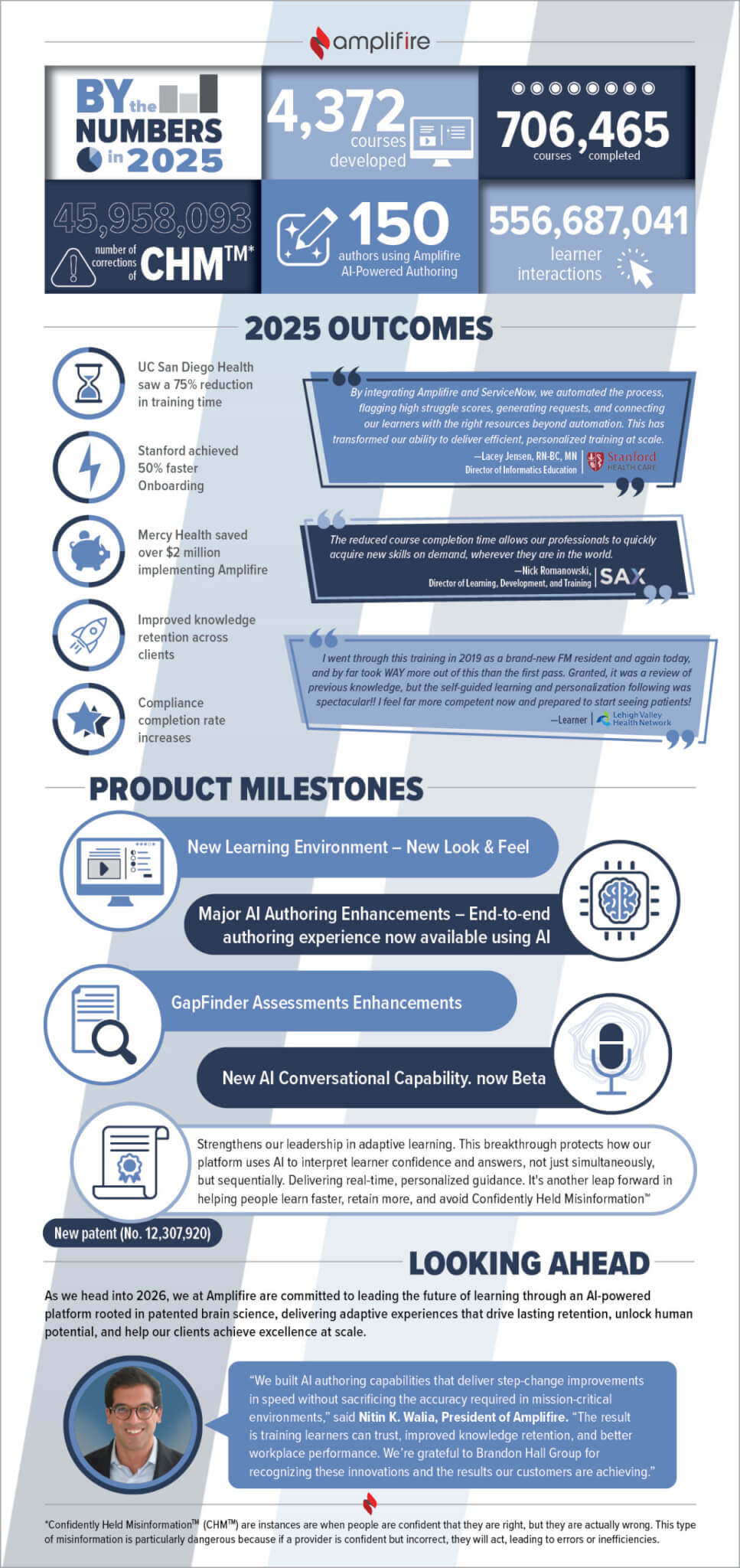
- Over 706,000 courses completed.
- More than 556 million learner interactions.
- Nearly 46 million instances where Confidently Held Misinformation™ was surfaced and corrected.
But the real impact of those numbers is not volume. It is what they represent: people learning more efficiently, retaining critical knowledge longer, and showing up to their work more prepared and more confident.
Click to Enlarge From Activity to Impact
Training activity is easy to measure. Meaningful learning is harder, and that is where outcomes start to emerge.
We’ve seen health systems and organizations translate adaptive learning into tangible improvements.
- UC San Diego Health reduced training time by 75 percent, helping clinicians get where they were needed faster.
- Stanford Health Care achieved 50 percent faster onboarding without sacrificing depth or quality.
- Mercy Health saved over $2 million by modernizing compliance training, freeing up time, budget, and attention for patient care.
These outcomes were not driven by shortcuts. They came from rethinking how learning works, recognizing that not every learner needs the same content, that confidence matters as much as correctness, and that insight into struggle and uncertainty is just as important as test scores.
Across clients, we also saw consistent improvements in knowledge retention and compliance completion. These are quiet wins that do not always make headlines, but they make a real difference in safety, performance, and trust.
Learning That Adapts to People, Not the Other Way Around
One of the clearest themes we heard from learners themselves was appreciation for personalization.
A resident at LVHN reflected on retaking a course years later and coming away with far more value the second time. The content was familiar, but the experience was different. Self-guided, adaptive learning allowed prior knowledge to be respected and gaps to be addressed without friction. The result was greater confidence and stronger preparation for seeing patients.
That sentiment showed up again and again. When learning adapts to individuals rather than forcing everyone through the same path, it becomes something people engage with, not something they endure.
From a global professional services perspective, SAX LLP highlighted how reduced course completion times made it possible for professionals to acquire new skills on demand, wherever they were in the world. In fast-moving environments, time is not just money. It is relevance.
Behind the Scenes: Building Better Tools for Learning
Progress at this scale does not happen without sustained investment in the platform itself. In 2025, we doubled down on innovation with platform improvements including:
- A new learning environment with an updated look and feel designed to reduce friction and make engagement more intuitive.
- Major enhancements to AI-powered authoring, enabling an end-to-end experience that helps subject matter experts move faster without compromising accuracy. Today, more than 150 authors are already using AI as part of their workflow, contributing to over 4,300 courses developed.
- GapFinder Assessments continued to evolve as well, giving organizations clearer insight into where knowledge gaps, uncertainty, and risk actually live before they show up in practice.
We also expanded our AI roadmap with a new conversational capability now in beta and moving toward broader availability. The goal is not novelty. It is support, meeting learners where they are in the moments they need guidance most.
Another important milestone was the issuance of U.S. Patent No. 12,307,920. This strengthens protection around how the platform uses AI to interpret learner confidence and answers sequentially, not just simultaneously. It is a technical achievement with a very human purpose: helping people avoid confidently held misinformation, learn faster, and retain what matters.
Systems, Not Silos
One of the most encouraging signs of maturity we saw was how organizations began integrating learning more deeply into their operational ecosystems.
At Stanford Health, integrating Amplifire with ServiceNow enabled automated workflows that flagged struggle, generated requests, and connected learners with the right resources without adding administrative burden. As Lacey Jensen, RN-BC, MN, Director of Informatics Education, shared, this approach transformed training from something reactive into something responsive and personalized at scale.
This kind of integration signals a broader shift. Learning is no longer a standalone event. It is becoming part of how organizations sense risk, support people, and continuously improve.
The Human Side of Scale
For all the technology, patents, and metrics, what we are most proud of is the community behind the work.
Customers who co-develop content and share what they are learning. Educators and clinicians who push for better ways to train their teams. And internally, a group of people who care deeply about the impact of what they build.
As one team member put it, there is something rare about working in a place where you can make a difference, trust your leadership, and genuinely enjoy the people around you. Another reflected on how being together, stepping away from screens and roadmaps, was a reminder that the best feature of the platform might actually be the people behind it.
That culture matters because learning is fundamentally human. Tools can accelerate it, but empathy, collaboration, and integrity sustain it.
Carrying Momentum Forward
As we continue into 2026, the focus is not on celebrating past milestones. It is on building from them.
The challenges facing today’s workforce are not easing. Turnover, burnout, skills gaps, and rising expectations remain very real. At the same time, there is momentum and proof that smarter, adaptive learning can reduce burden, restore confidence, and create space for people to do their best work.
We remain committed to leading the future of learning through an AI-powered platform rooted in patented brain science. One that drives lasting retention, unlocks human potential, and helps organizations achieve excellence at scale.
Not because learning is trendy.
But because when learning matters, outcomes do too. -
Amplifire Recognized by Brandon Hall Group for Breakthrough AI Authoring Technology
BOULDER, Colo., Feb. 3, 2026 /PRNewswire/ — Amplifire, the leading adaptive learning platform built on patented brain science, has been honored by Brandon Hall Group with two bronze awards in the 2025 Excellence in Technology Awards for Best Advance in Content Authoring Technology and Best Advance in AI for Business Impact. The recognition highlights Amplifire’s continued innovation in solving critical training and workforce development challenges with AI-powered tools that deliver measurable impact.
At the core of this recognition is Amplifire’s latest AI-driven authoring platform. Released as part of Version 8.0, the platform delivers an intuitive, end-to-end course development experience that empowers instructional designers and subject matter experts to accelerate training while improving accuracy and trust. New capabilities include AI-generated course planning, integrated storyboarding, smarter refinement tools, and advanced content verification. These enhancements are helping teams reduce development time by weeks while maintaining the rigorous standards required in high-stakes industries like healthcare, accounting and aviation.
“We built AI authoring capabilities that deliver step-change improvements in speed without sacrificing the accuracy required in mission-critical environments,” said Nitin K. Walia, President of Amplifire. “The result is training learners can trust, improved knowledge retention, and better workplace performance. We’re grateful to Brandon Hall Group for recognizing these innovations and the results our customers are achieving.”
Amplifire’s clients are already seeing results. Devan Berkley, Senior Training Specialist at UW Medicine, said, “It used to take two and a half, almost three months to create a new training course. Now we’re doing it in just two weeks. That’s not just a technology win, it’s a workforce win.”
Built on more than 5 billion learning interactions and trusted by leading health systems, Amplifire uses patented confidence-based learning to surface Confidently Held Misinformation™ and deliver actionable analytics. Its flexible, AI-supported authoring platform makes it easier than ever to scale personalized learning for onboarding, compliance, career laddering, and more.
About Amplifire
Amplifire is the world’s leading adaptive learning platform, built from patented brain science discoveries and informed by billions of learner interactions. Its AI-powered tools help organizations reduce costs, save time, and improve outcomes through smarter, personalized training. From EHR onboarding to clinical risk reduction, Amplifire partners with high-stakes industries to elevate performance, safety, and satisfaction.
Learn more at www.amplifire.com
About Brandon Hall Group™
Brandon Hall Group™ is the home of the HCM Excellence Awards® – the most prestigious and sought-after awards in Human Capital Management. For over 30 years, these awards have set the gold standard in recognizing organizations for innovative and effective HCM practices across Learning and Development, Talent Management, Leadership Development, Diversity, Equity & Inclusion, Human Resources, Sales Performance, and Technology.Source: PR Newswire
-
When Two Wrongs Make a Right: What Video Speed Tells Us About Learning
Matthew Hays, Ph.D., SVP Research and Analytics at Amplifire
Insights from my recent presentation at Psychonomics on why learners can’t trust their instincts about what works.
People are really bad at managing their own learning. A big reason for that: They mistake how easily something comes to mind right now for how easily it’ll come to mind later.
Imagine two people getting ready to give their own conference presentations. Suppose Beth practices her talk once a day for each of the four days before the conference, and suppose Bill practices his talk four times in a row on the day before the conference. At the end of his marathon practice session, Bill’s going to be feeling amazing. But the next day, Beth’s talk is going to go more smoothly. Bill’s going to be scratching his head, wondering how practice went so well, but the talk went so poorly.
Two things are at play here. One is the spacing effect, which is one of the most powerful cognitive phenomena on record. It’s the finding that spreading your practice sessions over time massively increases how much you learn. (Side note: If you don’t do anything else to improve your memory, use spacing!)
But the other thing going on here is that Bill is mistakenly interpreting his great performance during practice as evidence of great learning. What really happened: Beth set her practice sessions up to be more difficult while she was practicing, but to produce better learning as a result. Bill set his practice sessions up so that he would improve as rapidly as possible…but at the cost of tomorrow’s talk.
Phenomena like the spacing effect are called desirable difficulties, which are challenges during learning that create better long-term retention. But they’re unintuitive; people don’t know about them and instinctively avoid them, like Bill did. Instead, they gravitate toward what Dr. Dillon Murphy and I call evil easies: conditions of learning that make you think you’re learning a ton but then leave you hanging.
There are all sorts of ways that people’s misconceptions about their learning cause them to mismanage it. Dr. Murphy and I looked at a particular decision people make, both during their formal education and in the corporate world: Speeding up the playback of instructional videos. In some previous research, Dr. Murphy found that only about 15% of undergraduate students watch pre-recorded lecture videos at normal speed; the rest accelerate videos to various extents.
Their decision to speed up videos becomes interesting in light of some other data that Dr. Murphy collected. He found that speeding up videos, all the way to double speed, did not impair learning! But when he asked his research participants about it, he found that 42% of them thought that normal speed (1x) was best for learning. …But wait, we also know that only 15% of students watch at 1x speed. Clearly, some students are speeding up their lecture videos even though they think it’s bad for their memory.
Here’s the twist: In addition to selecting the “worse” option for their learning, they were also wrong about the trade-off! Because speeds up to 2x don’t hurt learning, these students were making the right practical decision saving time without sacrificing comprehension – while being completely mistaken about what they were doing to their learning. Two wrongs made a right!
What This Means
At Psychonomics this year, Dr. Murphy and I presented these data as yet more evidence that learners are lousy managers of their own learning. They’re often wrong about how learning works, and they also often fail to act in accordance with their own beliefs. In other words, they have fundamentally flawed metacognition.
Our presentation was remarkable not because we demonstrated learners’ metacognitive failures – plenty of researchers have done that – but because in this case two metacognitive errors canceled each other out. Most times, learners aren’t so lucky.This is where Amplifire comes in. We can’t rely on learners’ intuition to guide their study strategies…but we can design systems that guide learners toward empirically validated, efficient learning behaviors. Well-designed tools like Amplifire can turn accidental success into consistent success.
-
Mental Health Awareness Month: Combating Burnout Through Confidence and Connection
May marks Mental Health Awareness Month—a critical time to acknowledge how burnout and job dissatisfaction are affecting employees across industries. The American Psychological Association found that 77% of U.S. workers experienced work-related stress in the past month, and more than half reported negative health impacts, including emotional exhaustion and lack of motivation.
In the healthcare industry and beyond, chronic burnout is a serious challenge. Employees who feel overwhelmed or unsupported are more likely to disengage, take time off, or leave their jobs altogether. That’s why creating a work environment that fosters confidence, clarity, and connection is essential—not just for productivity, but for mental well-being.
The Power of Purposeful Training
Training is more than a compliance requirement—it can be a meaningful tool for boosting confidence, reducing stress, and reinforcing a sense of purpose. At Amplifire, we’ve seen firsthand how thoughtful, job-relevant learning can transform how people feel about their roles.
As one leader from UCHealth shared:
“When front-end staff feel confident and empowered in their role, the whole organization benefits. With training that respects their time and expertise, front-end staff see their role within the bigger picture and gain confidence, empowering them to take charge of their careers.”
One area where this impact is especially clear for healthcare is in revenue cycle management (RCM). Non-clinical staff in registration, billing, and financial counseling often work under high-pressure conditions with little recognition. Giving them training that supports growth and interdepartmental understanding has sparked overwhelmingly positive feedback:
- “This course should be an annual requirement for all non-clinical staff.”
- “It helped me see how my role fits within the bigger picture.”
- “This was a very informative course—more than I expected to learn.”
Supporting Mental Health at Work
Whether you’re in healthcare, tech, finance, or education, the principles are the same: employees do better when they feel supported and capable. Here are a few ways organizations can improve workplace mental health:
- Offer engaging, time-efficient training that builds confidence and competence.
- Encourage cross-team understanding to reduce silos and improve communication.
- Recognize growth and effort, not just output.
- Cultivate psychological safety, where it’s okay to ask for help and speak up.
Mental health is a shared responsibility—and small changes can create lasting impact. By investing in tools that reduce stress and empower employees, companies can foster workplaces where people thrive.
References
- Workplace Stress Prevalence: According to the American Psychological Association’s 2023 “Work in America Survey,” 77% of U.S. workers reported experiencing work-related stress in the past month.
- Negative Health Impacts: The same survey found that 57% of workers reported negative health effects due to work-related stress, including emotional exhaustion and lack of motivation.
-
Elevating Clinician Training: The promise of AI for Personalized Workforce Development, a conversation with Amplifire
Elevating Clinician Training: The promise of AI for Personalized Workforce Development, a conversation with Amplifire
In a recent episode of the Becker’s Healthcare podcast, Lukas Voss spoke with Bob Burgin, CEO of Amplifire, about the transformative role AI and adaptive learning are playing in healthcare workforce development. The conversation highlights the urgent need to address staffing shortages, particularly among nurses, and how personalized, AI-driven training is not only enhancing clinical performance but also improving patient care.
-
Amplifire Named to the 2025 GSV 150: A Top Transformational Growth Company in Digital Learning & Workforce Skills
Recognized among the world’s top 150 private companies driving advancements in digital learning, Amplifire’s adaptive learning technology is empowering organizations to revolutionize workforce performance and resilience.
Boulder, Colorado, Dec. 17, 2024 (GLOBE NEWSWIRE) — Amplifire, the leading adaptive learning platform, has been named to the prestigious 2025 GSV 150, GSV Ventures’ annual list of the top 150 private companies globally transforming digital learning and workforce skills.
The GSV team evaluated over 2,500 companies worldwide, assessing five key factors: revenue scale, revenue growth, user reach, geographic diversification, and margin profile. This year’s GSV 150 represents a collective impact on three billion learners and over $25 billion in annual revenue.
Amplifire’s inclusion recognizes its innovative workforce development solutions that empower organizations to transform and grow their workforce to meet the demands of an evolving future. By leveraging its science-based learning platform, Amplifire helps organizations improve employee performance, reduce risk, and adapt effectively in dynamic industries.
“We’re honored to be recognized as a transformational leader in digital learning,” said Nitin Walia, President of Amplifire. “This accolade underscores the critical role Amplifire plays in preparing organizations for the future. By equipping workforces with adaptive learning tools and strategies, we help our clients achieve measurable improvements in operational performance and workforce resilience.”
Luben Pampoulov, Partner at GSV Ventures, said, “The rapid rise of generative AI is fueling knowledge and creating opportunities we had not imagined before. Multi-modality is making education more engaging, AI tools are driving personalization and productivity, and learning is happening at the speed of light. Effectively everyone across the 2025 GSV 150 has generative AI deeply embedded in their offering.”
GSV Ventures noted that the 2025 GSV 150 reflects significant advancements in digital learning, including the integration of generative AI to drive personalization and productivity, further reinforcing Amplifire’s leadership in the space.
View the full GSV 150 list at https://www.asugsvsummit.com/gsv-150.
About Amplifire
Amplifire is a next-generation adaptive learning platform with more than four billion learner interactions and is an innovator in high-stakes workforce training for critical roles. The Amplifire platform harnesses advances in cognitive and learning science to create personalized learning and drive successful outcomes. The platform’s adaptive algorithm guides millions of learners to mastery across healthcare, accounting and professional services, government, military, food service, corporate, and education segments, providing unique learner analytics that offer valuable insights.Source: GlobeNewswire

-
What is Confidently Held Misinformation?
Amplifire’s Patented, Confidence-Based Learning® Approach Explained
In educating learners, ensuring that learners understand and apply their knowledge correctly is paramount. However, one of the most insidious barriers to effective learning is Confidently Held MisinformationTM (CHMTM). Confidently Held Misinformation (CHM) instances occur when individuals believe they understand a concept or process but have actually learned it incorrectly—they are confident and wrong. Amplifire’s adaptive, confidence-based learning platform is designed to tackle this challenge head-on by identifying and correcting CHM. But what exactly is CHM, and why is it so critical to address? Let’s explore.
Understanding Confidently Held MisinformationTM
CHM occurs when a person is convinced they know something accurately, but in reality, they have learned it incorrectly or have misunderstood the information. This type of misinformation is particularly dangerous because the confidence with which the incorrect information is held makes it harder to detect and correct.
For example, an employee might confidently believe they understand the proper procedure for handling a piece of machinery, but if they’ve misunderstood a critical step, this misinformation can lead to errors, inefficiencies, or even dangerous outcomes. The confidence they have in their incorrect knowledge means they are unlikely to seek out clarification or further training, perpetuating the misinformation.
The Dangers of Confidently Held MisinformationTM
The impact of CHM can be far-reaching:
- Errors in Execution: Employees who act on CHM are likely to make mistakes. These errors can range from minor inefficiencies to major incidents that compromise safety, quality, and productivity.
- Increased Risk: In industries where precision and accuracy are critical, such as healthcare, manufacturing, or finance, CHM can pose significant risks. For instance, a healthcare professional who misremembers a dosage calculation could endanger a patient’s life.
- Resistance to Learning: When employees are confident, they may be resistant to corrective feedback or additional training. They may believe that further learning is unnecessary, which perpetuates the problem and makes it more difficult to correct.
- Wasted Resources: Training programs that fail to identify and correct CHM may lead to wasted time and resources. Employees may pass through training modules without realizing they’ve misunderstood key concepts, leading to continued mistakes on the job.
How Amplifire Addresses Confidently Held MisinformationTM
Amplifire’s patented confidence-based learning platform is specifically designed to identify and correct CHM through a combination of advanced algorithms, data analytics, and real-time feedback mechanisms. Here’s how the platform works:
- Initial Assessments to Gauge Understanding: Amplifire begins by assessing the learner’s current knowledge and confidence levels. The platform presents questions and scenarios designed to probe the learner’s understanding of key concepts.
- Confidence Calibration: Importantly, Amplifire also asks learners to rate their confidence in their answers. By comparing learners’ confidence levels with the accuracy of their answers, Amplifire can identify areas where CHM exists. If a learner is confident but incorrect, the platform flags this as an area that needs attention.
- Targeted Feedback and Remediation: When CHM is detected, Amplifire provides both immediate and delayed targeted feedback. This feedback is designed to address the specific misconceptions the learner holds, offering explanations, clarifications, and additional resources to correct the misinformation.
- Adaptive Learning Paths: Based on the identified CHM, Amplifire adjusts the learner’s path to ensure that they spend more time on areas where misunderstandings exist. The platform may present similar questions in different contexts or provide additional practice to reinforce the correct information.
- Continuous Monitoring and Adjustment: Amplifire continuously monitors the learner’s progress, adjusting the learning experience as needed to ensure that CHM is corrected. This ongoing adaptation helps prevent the re-emergence of incorrect knowledge and promotes long-term retention of accurate information.
The Importance of Identifying and Correcting Confidently Held MisinformationTM
The primary goal of any training program is to ensure that employees can accurately apply what they’ve learned in real-world scenarios. CHM undermines this goal by leading to mistakes and errors in execution, which can have serious consequences. By identifying and correcting these misconceptions, organizations can reduce risk, enhance safety, and ensure compliance with industry standards. Correcting CHM also improves overall learning outcomes since learners who receive targeted feedback and remediation are more likely to retain accurate information and apply it effectively.
By focusing on areas where misinformation exists, Amplifire’s adaptive, confidence-based learning platform ensures that training is both efficient and effective. This targeted approach minimizes wasted time and resources, allowing employees to focus on areas where they need the most support. Respecting learners’ time with personalized learning fosters a culture of continuous learning and improvement. Employees become more open to feedback, more aware of their knowledge gaps, and more proactive in seeking out additional learning opportunities.
Interested in learning more about how to correct CHM at your organization?
-
The Do’s and Don’ts of Microlearning
In recent years, “microlearning” has emerged as a buzzword in corporate training and development. Its appeal is clear: short, bite-sized learning modules designed to fit seamlessly into our fast-paced lives.
With the demand for quick fixes on the rise, microlearning might seem like the perfect approach for anyone in today’s business landscape. Microlearning is being widely adopted across many industries. For example, a 2023 study by the Association for Talent Development (ATD) found that 73% of pharmaceutical companies already use microlearning for various training purposes, including compliance.
Microlearning offers several key benefits that make it an appealing option for modern training environments. By delivering content in brief, focused segments, it caters to shorter attention spans and helps maintain learner engagement. Microlearning also allows for flexibility in learning, as employees can fit complete training sessions into their schedules more easily and access information exactly when they need it. Additionally, microlearning supports ongoing skill development by making it simple to revisit and reinforce key concepts regularly, which should solidify them in memory. This continuous learning process not only aids in knowledge retention but also helps in the quick application of skills in real-world scenarios, leading to more effective performance and decision-making.
But microlearning may be overused. Kathleen McDermott, a professor at Washington University in St. Louis, cautions that “very short learning experiences might be valuable for experts, but that’s not how to introduce new information in most cases.” Learning intended to last should be spread out over time rather than compressed into a short, single session. UCLA’s Professor Robert Bjork explains that “skills learned in very short sessions do not stay accessible across delays and context changes.”
Roddy Roediger, also a Professor at WashU, emphasizes that “micro-learning works great as a refresher, if something is really important and stored in someone’s mind but they haven’t had to retrieve it in a while.”
As with any trend, there are best practices—and pitfalls—you should be aware of.
What You Should Know About Microlearning
Microlearning is not a one-size-fits-all solution. While it offers flexibility and accessibility, knowing when and how to use it effectively is crucial. Here’s what the experts have to say:
When to Use Microlearning
- Supplemental Learning: Use microlearning to reinforce and supplement longer training sessions. It helps refresh learners’ memory and solidify key concepts.
- Just-in-Time Training: Ideal for equipping employees with immediate, relevant information—perfect for roles that require quick decision-making or adaptation.
- Targeted Skills: When you need to focus on specific skills or communicate a single topic, microlearning can be highly effective.
- Lots of On-the-job Reinforcement: Bob Bjork points out that “skills given massed practice in a single context do not stay accessible when needed later or in a new context.” Microlearning – when used to revisit material over time – can help keep these skills top of mind and readily available.
When Not to Use Microlearning
- Complex Topics: Deep, intricate topics requiring comprehensive understanding should not be broken into microlearning modules. They may lead to fragmented understanding.
- Foundational Knowledge: Building a strong knowledge base often requires more immersive, longer-form learning experiences.
- Over-reliance: Using microlearning as the sole form of training can lead to knowledge gaps. It should complement, not replace, traditional learning methods.
Amplifire eLearning & Microlearning Excellence
Amplifire’s eLearning Platform harnesses the power of microlearning to address specific training challenges effectively. By breaking down complex healthcare processes into manageable pieces, Amplifire ensures that doctors and nurses not only retain core procedures but also apply them accurately under pressure.
Bob Bjork, Research Professor at the University of California, Los Angeles, highlights the importance of periodic simulated practice for critical skills, such as emergency procedures. He notes, “If skills or procedures are very important but rarely exercised—like shutting down and restarting a nuclear reactor or how firefighters should enter a burning building—periodic simulated practice is essential to keep those skills accessible when needed.”
How do we do this? Amplifire allows microlearning without forcing it. A user can master one, ten, or one hundred concepts in a session. The learner is empowered to manage their own learning. Additionally, we couple microlearning with our patented Confidence-Based Learning® model, which identifies areas of uncertainty and strengthens them through scientifically scheduled repetition. This method not only enhances retention but also builds confidence in learners’ abilities to perform critical tasks.
Conclusion
Microlearning has significant potential in corporate training and development, but it must be applied thoughtfully. Understanding when it works best—primarily as a refresher, as Roddy Roediger suggests—and when it might fall short will help you craft a learning strategy that leverages its strengths while addressing its limitations.
Ready to see how microlearning can elevate your training strategy? Start by evaluating your current learning needs and explore how microlearning can complement your efforts for more dynamic and impactful outcomes. Remember, the goal is not to replace traditional methods but to enhance them, creating a more agile and effective learning culture.
-
What did the pandemic do to distractions during online learning?
It is hard to overstate the impact of the COVID-19 pandemic on everyday life. Downtown real estate markets collapsed as remote office work became the norm. Supply-chain issues caused widespread food insecurity and prescription medication shortages. Lockdowns even changed how birds sing.
Education was similarly disrupted. Within weeks, over 90% of classrooms abruptly shifted from in-person to online. At the same time, the upheaval caused by lockdowns and students’ concerns about the virus caused them to report increased anxiety, difficulty sleeping, concentration problems, and greater susceptibility to distractions.
Amplifire’s Dr. Matthew Hays and Scott Kustes teamed up with Dr. Elizabeth Bjork of our Science Advisory Board to investigate how this disruption affected learners’ ability to stay engaged while learning online. Because learners have interacted with the Amplifire platform over 4.5 billion times, there were more than enough data points to let the researchers quantify the impact of the pandemic.
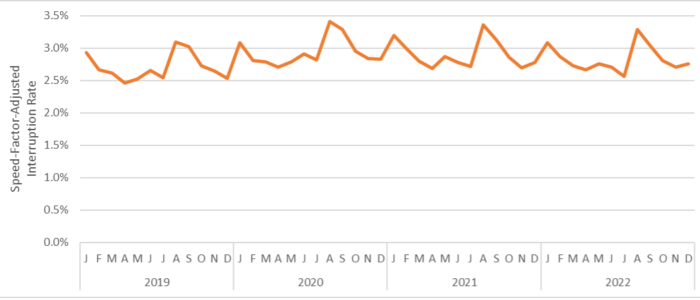
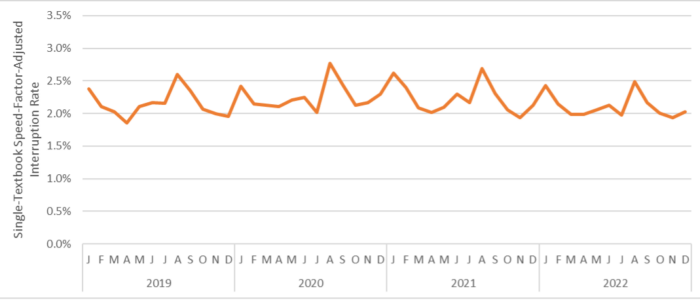
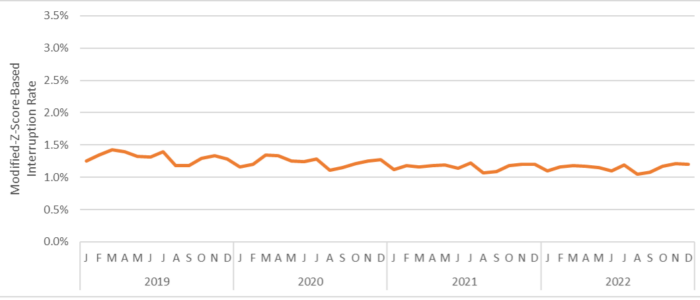
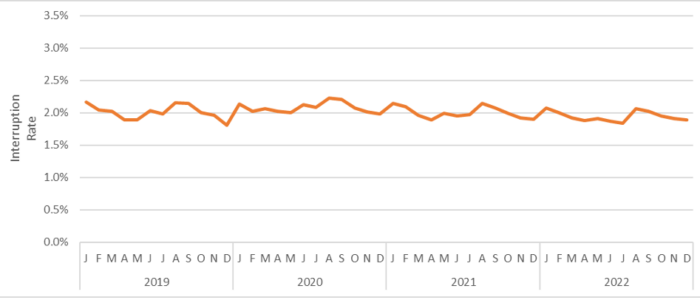
Their first step was to define what constituted an interruption. Over the course of five studies, they evaluated increasingly rigorous ways to detect within the data when a student became distracted, from simple mean-and-standard-deviation approaches to more advanced statistical methods. They then compared the interruption rate during the peak of lockdowns – April and May of 2020 – to the same period in the years before and after. The researchers had hypothesized that there would be clear increases in the frequency of interruptions when lockdowns were most intense.
Instead, they found no effect of the pandemic.
We asked Dr. Hays to explain. “You’ll see these clickbait headlines that say ‘scientists stunned’ and it turns out they just found a bug that they didn’t think lived in that part of the country anymore,” he said. “But I really was stunned. We pulled the data in different ways and re-ran the analyses to make sure that we weren’t somehow missing an impact.”
 Interruption Rate
The researchers consulted with several other experts in learning and metacognition to interpret the findings. The consensus that emerged: Because Amplifire was designed from the start to be used online, it was immune to the disruption that so dramatically affected classroom learning.The researchers’ findings and conclusions were published in the Journal of Intelligence, thus informing the broader scientific community about what we might expect from the next massive disruption of student learning. Further, the interruption-detection methods introduced can help educators identify frequently interrupted students (who may therefore be struggling to learn due to external factors rather than a lack of effort or aptitude). Click here to read the paper in full.
-
Amplifire Wins Silver in Brandon Hall Group’s Excellence in Technology Awards
Boulder, Colorado, Feb. 27, 2024 (GLOBE NEWSWIRE) — The 2023 Brandon Hall Group Excellence in Awards™ are given for work in Learning and Development, Talent Management, Talent Acquisition, Human Resources, Sales Enablement, Future of Work, and Education Technology.
Amplifire, a leader in innovative adaptive eLearning and content development, won two coveted Brandon Hall Group Silver awards for excellence in the “Best Advance in Content Authoring Technology” and “Best Advance in AI and Machine Learning” categories.
The winners are listed at https://excellenceawards.brandonhall.com/winners/
Amplifire submitted for two categories best representing its latest product launch, including its new authoring platform. The new authoring platform offers cutting-edge content creation capabilities to transform development and time-to-delivery of high-quality instructional material with the power of artificial intelligence (AI), enabling users to spend less time on ideation and planning and more time elevating content. This recognition underscores Amplifire’s commitment to eLearning excellence and dedication to staying ahead of the AI curve to provide the best learning experiences. It is the company’s second consecutive year securing multiple Brandon Hall Group Tech Excellence awards.
Amplifire Chief Product Officer, Nick Hjort, shares, “We are honored to be recognized among the top innovators in the industry. We’ve taken content creation to new heights, elevating the content development process to deliver an exceptional experience. The incorporation of AI is a game-changer, ushering in a more autonomous, intuitive, and expedient course creation process, resulting in the delivery of top-tier educational resources.”
“In our 30th year, the Excellence in Technology Awards continue to showcase the best innovations in learning, talent management, talent acquisition, HR, workforce management, and sales enablement technologies. We are proud to receive applications from a diverse range of organizations globally, reflecting the ever-evolving landscape of technology solutions” said Brandon Hall Group Chief Operating Officer Rachel Cooke, leader of the Excellence Awards program.
Entries were evaluated by a panel of veteran, independent senior industry experts, Brandon Hall Group analysts, and executives based upon these criteria: fit the need, program design, functionality, innovation, and overall measurable benefits.
“Our awards program is distinguished by the thorough evaluation process led by industry experts. Judges meticulously score each entry, and our executive leadership team at Brandon Hall Group reviews and validates the judging and scoring. The level of the award is solely determined by the number of points, ensuring a fair and unbiased recognition of excellence in technology,” said Brandon Hall Group Chief Executive Officer Mike Cooke.
About Amplifire
Amplifire is a next-generation learning platform with more than four billion interactions and is an innovator in high-stakes training for critical roles. The Amplifire platform harnesses advances in cognitive science to create personalized learning and drive successful outcomes. The platform’s adaptive algorithms guide millions of learners to mastery across healthcare, government, and other industries, providing unique analytics that offer valuable learner insights.
About Brandon Hall Group™
Brandon Hall Group is the only professional development company that offers data, research, insights, and certification to Learning and Talent executives and organizations. The best minds in Human Capital Management (HCM) choose Brandon Hall Group to help them create future-proof employee development plans for the new era.
For over 30 years, we have empowered, recognized, and certified excellence in organizations worldwide, influencing the development of over 10 million employees and executives. Our HCM Excellence Awards program was the first to recognize organizations for learning and talent and is the gold standard, known as the “Academy Awards of Human Capital Management.”
The awards recognize the best organizations that have successfully developed and deployed programs, strategies, modalities, processes, systems, and tools that have achieved measurable results. We are honored to receive applications from organizations worldwide ranging from small, medium, large, and global enterprises to government, not-for-profits, and associations.