-
Clinician-Centered, Data-Driven: How AHN Transformed OB Risk Training with Amplifire
Personalized education. Smarter insights. A safer environment for mothers and babies.
Allegheny Health Network (AHN) recognized a growing challenge within its obstetrics (OB) risk reduction training. A generic, one-size-fits-all program was falling short of addressing the unique needs of individual clinical roles. Clinicians with extensive experience were required to sit through content they had already mastered, while new staff lacked the targeted support they needed to build competence and confidence. On top of that, AHN had limited visibility into who was struggling, and the platform could not be tailored to reflect their specific protocols.
Rather than settle for the status quo, AHN took action. By partnering with Amplifire, they shifted to an adaptive, clinician-centered training model that respects prior knowledge, surfaces knowledge gaps, and delivers role-specific content that reflects the way their teams actually work.
The Turning Point: From Generic to Purposeful Learning
Before 2024, AHN’s OB training was built on a platform that treated all learners the same. Everyone received identical content regardless of experience level or specialty. The system lacked flexibility, which meant that even as protocols evolved, AHN could not easily update or customize training materials.
Clinicians were frustrated by training that didn’t feel relevant. Leadership lacked the tools to track progress and identify areas of concern at the individual level. Most critically, there was no way to detect the presence of misinformation—a dangerous blind spot in a high-stakes field like obstetrics.
AHN knew it needed a smarter approach.
Partnering with Amplifire: Tailored, Adaptive, and Data-Rich
OB subject-matter experts at AHN worked closely with Amplifire’s instructional design team to create customized content that aligned with facility-specific workflows and protocols. This collaboration resulted in a modern learning experience that felt relevant to every clinician, regardless of role or tenure.
Amplifire’s Confidence-Based Learning™ platform enabled clinicians to move quickly through content they already understood while focusing learning time on areas of uncertainty or misinformation. The platform’s adaptive engine delivered personalized learning paths and immediate feedback, creating a more efficient and engaging training experience.
Equally important, AHN gained access to detailed analytics through Amplifire’s dashboard. For the first time, Nursing Professional Development specialists could see exactly where clinicians were struggling, identify Confidently Held Misinformation™, and intervene before gaps in knowledge reached the bedside.
As Emily Hempel, MSN, RN, RNC-MNN, C-EFM, NPD-BC, Nursing Professional Development Specialist for Labor & Delivery and Antepartum shared:
“We can now identify areas where additional support is needed for our team and provide that support so that everyone has the best training experience possible.”
Early Results: Positive Feedback and Time Savings
While AHN did not have baseline metrics to quantify every outcome, early indicators showed clear improvements in learner engagement and training effectiveness. Following implementation, 99 percent of clinicians rated the training experience as effective, signaling strong adoption across roles and experience levels.
Clinicians responded positively to the adaptive learning experience and the ability to focus only on areas where reinforcement was needed. Learners shared feedback such as, “Love this learning style,” and “I like the fact that I only have to repeat what I did not get correct the first time.” This approach allowed experienced clinicians to move quickly through familiar content while providing newer team members with targeted support.
Learners also noted practical improvements in their day-to-day work. One clinician shared, “I will definitely be able to write better progress notes for the postpartum patients concerning course of delivery,” while another commented, “I will carry this knowledge to the workplace.”
Behind the scenes, Nursing Professional Development specialists gained clearer visibility into learner performance across individuals, topics, and locations. This insight enabled earlier intervention and more precise coaching.
Why It Matters: Building a Safer Environment
AHN’s ultimate goal was not just to improve training efficiency, but to reduce patient safety risks. In obstetrics, the cost of misinformation or delayed knowledge can be significant. By surfacing Confidently Held Misinformation and ensuring every clinician mastered essential protocols, AHN took a proactive step toward safer care.
This shift also reflects a broader commitment to workforce development. By respecting clinicians’ time and expertise, AHN strengthened satisfaction and engagement—key drivers of retention and performance.
A Model for What’s Next
AHN’s success with OB risk reduction training is already serving as a model for other departments. With Amplifire, they now have a scalable approach to delivering personalized, high-impact learning that adapts to their needs and evolves with their protocols.
In a time of workforce shortages and increasing complexity, AHN’s clinician-centered, data-driven approach sets a powerful example of how smarter training can drive better outcomes.
-
Precision Training Saves 2,920 Hours Annually for Froedtert Health
To reduce documentation burden and free nurses to focus more on patient care, Froedtert Health partnered with Amplifire to take a smarter, more efficient approach to training. Using Amplifire’s scenario-based GapFinder Assessment, the health system assessed all 1,887 inpatient nurses and identified exactly who needed support—only 24 percent. This meant 1,440 nurses avoided unnecessary training, saving over 4,000 hours immediately. Those who did require support received targeted in-person coaching designed to close performance gaps in areas like documentation latency and system efficiency.
The results were transformative. Within three months, nurses who had been struggling improved their documentation performance by up to 85 percent, achieving near parity with their top-performing peers. Across the full cohort, Froedtert saw a 4.6 percent reduction in active system time per shift hour, which equated to 2,920 hours saved annually. This success underscores the power of precision learning to drive measurable efficiency, ensure competency across the board, and alleviate one of healthcare’s most persistent pain points, all while honoring clinicians’ time and expertise.
Read the full Case Study -
OB Risk Management Through Structured Learning: Insights from ECRI
Obstetric teams face unique pressures: high-stakes situations, tight coordination requirements, and the need for consistent protocols across diverse care settings. Our recent OB Affinity group brings together OB leaders committed to improving the safety and quality of care through learning. In our recent session, we heard from ECRI, as they shared their evidence-based strategies for improving safety and team performance through adaptive, science-based learning.
Streamlining Compliance Through Individualized Training
ECRI’s presenters, Cara Wzorek, MA, MWC, Manager of Community Health & Clinical Safety, and Gina Bright, Program Coordinator for Community Health & Clinical Safety, demonstrated how Amplifire enables healthcare organizations to deliver individualized training at scale. “Meeting training and compliance requirements across clinics nationwide requires a solution that adapts to each learner’s knowledge gaps while ensuring consistent standards,” noted Cara. The session explored how Amplifire’s personalized learning approach helps clinics efficiently achieve compliance requirements while reducing training time and improving knowledge retention.
Key recommendations included using Amplifire’s adaptive learning technology to identify individual knowledge gaps across clinic staff, ensuring consistent training standards while accommodating different learning paces, and leveraging Amplifire’s data analytics to demonstrate compliance and track completion rates efficiently across distributed clinic networks.
Theory Meets Practice: Hometown Health’s Rapid Implementation
ECRI also highlighted how these principles work in real-world scenarios. Hometown Health Center faced a critical deadline: completing mandatory OB training for all credentialed staff to maintain their FTCA (Federal Tort Claims Act) coverage. Previously, only providers received this training, but new requirements expanded it to all support staff.
With financial stakes high and time short, Hometown Health contacted ECRI’s program coordinator, Gina Bright, who helped them quickly deploy Amplifire’s OB training modules. Within the day, staff members were enrolled and actively completing courses. The collaboration between ECRI’s expertise and Amplifire’s accessible platform enabled Hometown Health to meet their deadline and secure their FTCA award.
“Gina’s expertise, patience, and commitment made what initially seemed like a challenging process both smooth and efficient,” shared Darlene George from Hometown Health. “Because of her assistance, Hometown Health Center is now well-prepared and in full compliance.”
Key Takeaways for OB Teams
The combined insights from our discussion with ECRI and the Hometown Health experience point to several actionable strategies:
- Strengthen Safety Culture: Embed structured learning into regular team training to build consistency and trust.
- Leverage Expertise: Partner with organizations like ECRI and Amplifire that provide evidence-based tools and guidance for identifying safety gaps.
- Deploy Training Quickly to Meet Regulatory Demands: Choose platforms that offer both ready-to-use courses and rapid content development capabilities. When compliance deadlines emerge, having access to existing training modules or the ability to create custom content quickly can mean the difference between meeting requirements and facing penalties.
- Promote Continuous Learning: Sustained professional development reduces care variability and keeps teams prepared for evolving standards.
The Value of Personalized Learning at Scale
The partnership between ECRI and Amplifire demonstrates how adaptive learning technology can help healthcare organizations meet complex compliance requirements efficiently. By individualizing training to each learner’s specific knowledge gaps, clinics can reduce training time while ensuring consistent standards across all locations. As the session highlighted, Amplifire’s approach enables organizations to deploy required training quickly and track completion with confidence – critical capabilities for clinics managing regulatory requirements across distributed networks.
A Special Thank You to ECRI
We’re grateful to ECRI for sharing their expertise and actionable strategies during our OB Affinity Group. Their commitment to advancing patient safety and team performance continues to make a meaningful impact across healthcare organizations.Thank you to Cara, Gina, and the entire ECRI team for their partnership and dedication to improving obstetric care.
-
How 30 Minutes of Training Can Save Lives and Millions: Insights from Amplifire at LEAP HR
Dr. Matthew Hays, Amplifire’s VP of Research and Analytics, delivered a compelling talk at LEAP HR: Healthcare 2025 that challenged long-held assumptions about workplace training. His presentation, Leveraging the Science of Learning to Strengthen Your Workforce, wasn’t just about improving performance—it was about saving lives, cutting costs, and driving real change through scientifically informed eLearning.
The Stakes: Infection, Cost, and Human Lives
Dr. Hays opened with a striking example from healthcare: central line-associated bloodstream infections (CLABSIs). These occur when central lines—tubes inserted into the heart for administering medication—become contaminated by healthcare providers. The consequences are severe. One in six CLABSI victims dies, and survivors often suffer long-term complications. For hospitals, each infection carries an average unreimbursed cost of almost $50,000.
According to Dr. Hays, many efforts have been undertaken to reduce CLABSI rates. Most of these efforts are unsuccessful; CLABSIs are a stubborn problem and continue to challenge providers and administrators across the country and the world. Dr. Hays then shared data about an intervention that was able to cut CLABSI rates almost in half.
A Novel Intervention: Short, Science-Based Training
Before the training, the infection rate at one healthcare system was 1.08 CLABSI-related infection per 1,000 line days. After implementation, it dropped to 0.56—a 48% reduction.
Hays explained that, although one might expect to see effects of this magnitude from physical interventions (e.g., bacteria-resistant lines or gloves) or pharmaceutical developments (e.g., stronger antibiotics), this reduction in CLABSI was driven entirely by training. And it wasn’t a two-week-long, intensive, instructor-led course. It was a half-hour training session, delivered online.
This spectacular result wasn’t a one-off, either. A follow-up deployment used an improved version of the course, and compared CLABSI rates at a health system’s locations that used the training versus those that didn’t. The CLABSI rate dropped by eighty percent – but only at the locations where the training was used. Critically, all other anti-CLABSI efforts were consistent across the health system. Training alone drove the results.
Again, this wasn’t a massive overhaul or in-person workshop. It was a short, digital module.
Beyond Healthcare: Broader Workforce Applications
This approach doesn’t just work for CLABSI. Hays shared examples from other applications:
- One Healthcare Alliance member cut onboarding time from 250 hours to 125.
- Another slashed training costs from $2.5 million to $430K.
- A healthcare system using Amplifire for their nurse onboarding saw satisfaction jump from 14% to 59%, helping reduce first-year nurse turnover to zero.
The secret? A science-backed approach to how people actually learn.
Why Typical Training Fails
Hays explained that traditional training is built according to how people think learning works – not how it actually works. In reality, many of the best ways to arrange instruction are counterintuitive and therefore require research to be discovered. Amplifire incorporates these research-based techniques to help people remember information longer and be able to apply their skills more effectively.
23 Principles of Learning—Built In
Amplifire’s platform incorporates 23 principles discovered through decades of cognitive science research. These principles are designed to correct misconceptions, reinforce retention, and prepare employees to apply knowledge in critical situations. According to Dr. Hays, learners can feel the difference; they can feel that Amplifire is delivering information in the way their brains are built to learn.
Takeaway: Smarter Learning Drives Real Outcomes
What Amplifire has demonstrated is simple but powerful: when training aligns with how the brain actually learns, it works. It doesn’t need to be long or flashy—it needs to be right. From infection prevention to onboarding, the right training can reduce costs, increase satisfaction, and improve outcomes across the board.
References
Centers for Disease Control and Prevention. (n.d.). CLABSI 101 (STRIVE Infection Control Training). U.S. Department of Health and Human Services. https://www.cdc.gov/infection-control/media/pdfs/Strive-CLABSI101-508.pdf
-
Mental Health Awareness Month: Combating Burnout Through Confidence and Connection
May marks Mental Health Awareness Month—a critical time to acknowledge how burnout and job dissatisfaction are affecting employees across industries. The American Psychological Association found that 77% of U.S. workers experienced work-related stress in the past month, and more than half reported negative health impacts, including emotional exhaustion and lack of motivation.
In the healthcare industry and beyond, chronic burnout is a serious challenge. Employees who feel overwhelmed or unsupported are more likely to disengage, take time off, or leave their jobs altogether. That’s why creating a work environment that fosters confidence, clarity, and connection is essential—not just for productivity, but for mental well-being.
The Power of Purposeful Training
Training is more than a compliance requirement—it can be a meaningful tool for boosting confidence, reducing stress, and reinforcing a sense of purpose. At Amplifire, we’ve seen firsthand how thoughtful, job-relevant learning can transform how people feel about their roles.
As one leader from UCHealth shared:
“When front-end staff feel confident and empowered in their role, the whole organization benefits. With training that respects their time and expertise, front-end staff see their role within the bigger picture and gain confidence, empowering them to take charge of their careers.”
One area where this impact is especially clear for healthcare is in revenue cycle management (RCM). Non-clinical staff in registration, billing, and financial counseling often work under high-pressure conditions with little recognition. Giving them training that supports growth and interdepartmental understanding has sparked overwhelmingly positive feedback:
- “This course should be an annual requirement for all non-clinical staff.”
- “It helped me see how my role fits within the bigger picture.”
- “This was a very informative course—more than I expected to learn.”
Supporting Mental Health at Work
Whether you’re in healthcare, tech, finance, or education, the principles are the same: employees do better when they feel supported and capable. Here are a few ways organizations can improve workplace mental health:
- Offer engaging, time-efficient training that builds confidence and competence.
- Encourage cross-team understanding to reduce silos and improve communication.
- Recognize growth and effort, not just output.
- Cultivate psychological safety, where it’s okay to ask for help and speak up.
Mental health is a shared responsibility—and small changes can create lasting impact. By investing in tools that reduce stress and empower employees, companies can foster workplaces where people thrive.
References
- Workplace Stress Prevalence: According to the American Psychological Association’s 2023 “Work in America Survey,” 77% of U.S. workers reported experiencing work-related stress in the past month.
- Negative Health Impacts: The same survey found that 57% of workers reported negative health effects due to work-related stress, including emotional exhaustion and lack of motivation.
-
Healthcare Course Catalog
Course content has been co-developed and efficacy-tested by co-development partners at renowned Health Systems across the country. Course content can be quickly deployed as is, or there are opportunities to develop new course content, supported by a dedicated content and design team.
-
Recap of AONL 2025: Amplifire Highlights
The AONL 2025 event was a remarkable gathering of nursing leaders and innovators, setting the stage for the latest advancements in the nursing and medical fields. This year, Amplifire had the honor of participating and presenting groundbreaking insights on our adaptive learning platform and its critical role in reducing Hospital-Acquired Infection (HAI) rates with one of our esteemed clients, Providence. The event brought together a diverse group of professionals, all committed to improving patient care and healthcare outcomes through innovation and collaboration.
Throughout the presentation with Troy J. Larkin, PhD, RN Associate Vice President, Clinical Education & Nursing Research from Providence, we were able to emphasize how adaptive learning, with its personalized and data-driven approach, has proven to be a game-changer in the realm of clinical education. By identifying and addressing gaps in knowledge and correcting Confidently Held Misinformation™, our platform has significantly improved competency among healthcare professionals.
With improved competency, Providence saw improved outcomes. Larkin shared these substantial improvements in CAUTI (Catheter-Associated Urinary Tract Infections) and CLABSI (Central Line-Associated Bloodstream Infections) rates, showcasing a 51% decrease in CLABSI rates, equating to 85 cases avoided and 21 potential deaths prevented. These outcomes highlight the effectiveness of adaptive learning in enhancing patient safety and care quality.
Nurse Training at Scale: Decreasing HAI Rates with Adaptive Learning
During the presentation, we had the opportunity to share several crucial aspects of our adaptive learning platform that have driven these impressive outcomes. We highlighted the role of microlearning, which provides quick, focused educational interventions that are easy to integrate into busy clinical schedules. The use of patented Amplifire Analytics and Gap-Finder Technology was also a focal point, demonstrating how these tools identify and address knowledge gaps at both individual and departmental levels.
We discussed how our multi-interventional approach, tailored to the specific needs of different units, has led to remarkable improvements post-COVID. This stratified approach, combined with on-site practice observations and continuous feedback, has been instrumental in driving change and improving outcomes.
Expressing Gratitude to AONL for a Successful Event
We would like to extend our deepest gratitude to the AONL for hosting such a successful and impactful event. The opportunity to share our work and connect with like-minded professionals was invaluable. The AONL 2025 event not only highlighted the latest advancements in healthcare but also fostered a sense of community and collaboration that is essential for driving progress in the field.
In conclusion, our participation in AONL 2025 was a resounding success, and we are excited to continue our journey of innovation and excellence in healthcare education. We look forward to future opportunities to share our insights and collaborate with others who are equally passionate about improving patient care and outcomes. Thank you, AONL, for a great week!
-
2025 Healthcare Alliance Virtual Summit
On February 12, 2025, over 100 Healthcare Alliance members from over 30 healthcare organizations gathered to engage and experience the annual Healthcare Alliance Virtual Summit, Innovation Unleashed!
The outstanding accomplishments and results of our Healthcare Alliance were thrown into the spotlight this year and it made for a memorable and exciting hour!
Learn more by downloading our Post-Summit Program below.
-
Enhancing Patient Outcomes in Obstetrics Care: The Role of Quality Improvement
In recent years, maternal health in the United States has been declining. According to the Centers for Disease Control and Prevention, the maternal death rate in the US has risen steadily over the past decade, with the majority of these deaths being preventable. Combating this trend through quality improvement in obstetrics care has become a central focus. By implementing standardized care based on best practices and providing effective training, healthcare organizations have the power to significantly improve outcomes in obstetrics care and ensure patient safety.
The Impact of Quality Improvement
Quality improvement initiatives play a crucial role in achieving better patient outcomes in obstetrics care. Initiatives such as perinatal reviews and maternal quality collaboratives bring together healthcare providers from across the system to discuss and learn from cases of adverse outcomes, leading to performance improvement. Most healthcare organizations acquire international certifications, like the Joint Commission International Accreditation (JCIA), and accreditation of hospitals that recognize excellence in perinatal medicine. These initiatives ensure adherence to prescribed protocols and guidelines.
An example of standard care protocol success is a study on the California Maternal Quality Care Collaborative (CMQCC) Toolkit that provides approaches and strategies for providing care to women with maternal hemorrhage, hypertension, and severe sepsis. The implementation of this Toolkit averted 913 cases of severe maternal morbidity (SMM), 28 emergency hysterectomies, and one maternal death. It also resulted in $9 million saved.
The success of the Toolkit lies in its standardized, evidence-based protocols that greatly improve clinical management. “Quality improvement efforts in maternity care not only save lives; they can save costs,” said study co-author Elliott Main, MD, clinical professor of obstetrics and gynecology at Stanford Medicine and medical director of the California Maternal Quality Care Collaborative. Dollars saved can be reinvested into staff training to further improve maternal care and outcomes. For so many health systems that follow Joint Commission standards but still fall short of their patient safety goals, effective training is the link between having standards in place and ensuring standardized action and care. But implementing successful quality improvement training at scale can be challenging. Here are some critical points to consider.
Steps to successful quality improvement in obstetrics care
1. Utilizing the power of data analytics and technology
Obstetrics care also benefits significantly from data analytics and technology as the application of business intelligence systems can help monitor and analyze large volumes of data to identify likely adverse events. Predictive analytics can help detect early warning signs and intervene before an adverse event occurs. The use of electronic health records makes data recording, graphing, and analyzing easy, which can help identify deviations from standard care practices with ease. Technology also empowers patients to participate in their care plan by accessing data at any time and communicating with healthcare providers.
2. Reinforcing established standard practices with effective training
Establishing standard care processes, such as the Joint Commission’s, is just the beginning. It is equally important to ensure that these practices are understood, followed, and regularly updated. But simply offering training is not enough — clinicians need fast and effective training that works. Otherwise, the standard best practices health systems work so hard to identify and develop are useless. Continuous improvement of skills and knowledge, rigorous training exercises, and assessment can significantly enhance performance. By delivering safe and effective treatment during pregnancy, childbirth, and the postpartum period, healthcare providers can make a tangible difference in patient outcomes.
3. Prioritizing patient equity
Centers for Disease Control and Prevention (CDC) data reveals that American Indian/Alaska Native and Black women are 2 to 3 times as likely to die from a pregnancy-related cause than white women, among other figures that indicate racial disparities in obstetrics care and patient outcomes. Although this data created much-needed awareness around this issue, simply recognizing the problem does not translate to improved outcomes. Quality and improvement teams need clear action plans around this issue to be reinforced with effective training. Obstetrics departments that successfully tackle this gap in care will set themselves apart from those who do not make it a priority.
4. Emphasizing patient empowerment and informed consent
Patient empowerment is critical to enhancing obstetrics care outcomes and maximizing quality improvement efforts. Research indicates that patient education efforts have been proven to lead to more positive outcomes. Care goes beyond applying procedures or making a diagnosis. Patients and their families need to embody trust and collaborate in partnership with healthcare providers, enabling better decision making, and developing the understanding that supports shared goals and transparent communication. This way, patients are better empowered to make informed decisions about their care.
The declining maternal health statistics in the United States are alarming, and it is up to us as healthcare providers to adopt data-driven standardized care, reinforced by effective training, to enhance patient outcomes in obstetrics care. Implementing standard care practices, revisiting continuous learning and training, utilizing data analytics and technology, and empowering patients are just some of the critical elements that can be expanded upon to set the system on a positive trajectory. It is vital that those decision-makers who oversee care delivery invest in these strategies and make addressing the decline in maternal health statistics a priority. Ultimately, this will improve obstetrics care, increase maternal and infant safety, and empower women in their healthcare.
-
Recognizing Sepsis Awareness Month: Online learning for better patient outcomes
Regrettably, at least 1.7 million adults in America develop sepsis each year, leading to at least 350,000 sepsis-related deaths in the United States. On average, 87% of sepsis cases originate outside the hospital.
As sepsis continues to be a pressing issue in healthcare, action must be taken. Recently, in her first major initiative rollout as the director of the CDC, Dr. Mandy Cohen released the CDC’s Hospital Sepsis Program Core Elements. These guidelines offer a detailed roadmap for hospitals to follow to reduce deaths from sepsis in their facilities.
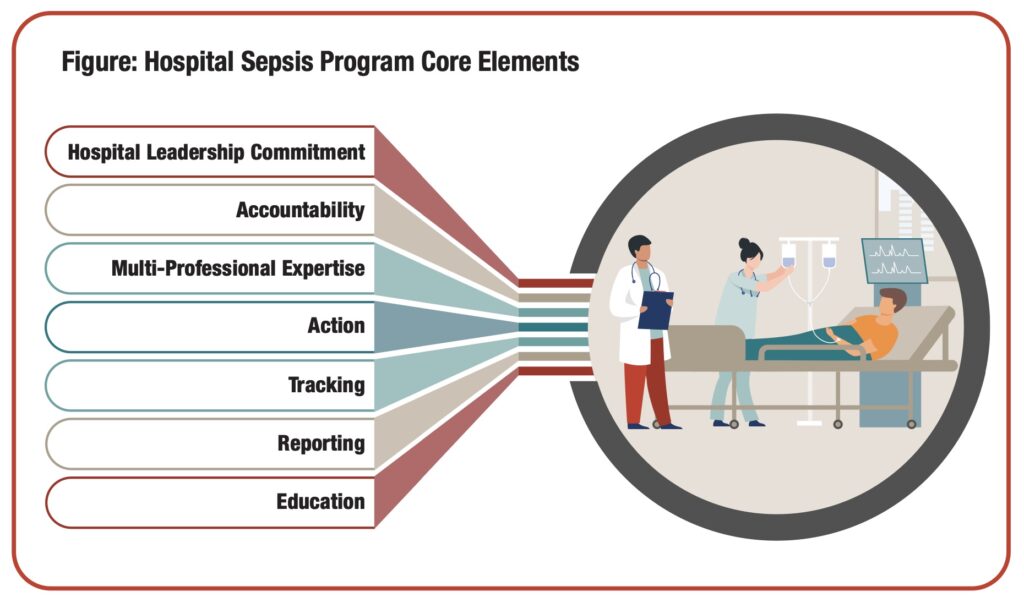
One of the seven core elements outlined in this roadmap is education. The CDC recommends, “For optimal sepsis treatment and outcomes, it is imperative that hospital staff have strong knowledge of sepsis and understand their role in team-based management of sepsis.” Examples of priority sepsis education include:
- Including sepsis-specific training and education in the hiring or on-boarding process for healthcare staff and trainees
- Providing annual sepsis education to clinical staff
The implementation of unified standard best practices delivered via effective education has been shown to improve patient safety, and can be applied to sepsis treatment, too.
A 2022 systemic review of thirty-two studies on the impact of sepsis education for healthcare professionals on patient outcomes concluded that most educational programs had an effective and immediate impact on knowledge levels, and simulation and game-based programs yielded better outcomes overall. It also concluded that, “Improvements in patient care processes and patient outcomes were associated with the concomitant existence or implementation of a hospital sepsis care bundle.” Effective training matters when standard best practices information needs to stick.
For example, central line-associated blood stream infections (CLABSIs) are often preventable — like sepsis — and rates can be reduced, if not eliminated, by adherence to evidence-based patient safety guidelines, reinforced by effective training. One hospital in a large Colorado healthcare system was selected to pilot the idea that CLABSIs could be addressed with training. After implementing Amplifire’s online learning platform, they experienced a 79% reduction in CLABSIs. A reduction of this magnitude has a profound effect, starting with improved patient outcomes, more confident and competent clinicians, a better bottom line, and most importantly, lives saved.
Want to learn more about how effective online learning can lead to decreased sepsis incidents and improved patient outcomes? Reach out. For more information about available sepsis courses, browse our course catalog.